SPOTLIGHT ARTICLE
It’s the 80th Anniversary of The Jack Benny Show? Well...!
By Ivan G. Shreve, Jr.
On March 19, 1932, stage and vaudeville comedian Jack Benny - who was at the time appearing on Broadway in Earl Carroll’s Vanities - agreed to appear on a radio program hosted by his good friend, newspaper columnist Ed Sullivan. He introduced himself to the people in Radio Land by saying: “Ladies and gentlemen, this is Jack Benny talking. There will be a slight pause while you say ‘Who cares?’
Two months later, Benny would headline his own radio comedy program, which premiered on May 2, 1932 for Canada Dry. And, eighty years after that debut, a generations both old and new continue to care about one of show business’ finest comedians.
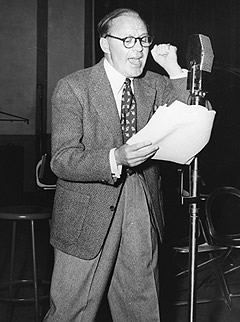 The unassuming Benny never came across as a visionary...but, he and his Jack Benny Program were instrumental in changing the face of radio humor, going beyond its early vaudeville influences to become what old-time radio historian John Dunning once termed “the quintessential American radio comedy show.” Many of the broadcasts emphasized character-based comedy and, having the show set against the background of preparing a weekly comedy program, made it essentially the first successful situation comedy. Instead of heckling his stooges for laughs, it was always vice versa. Jack’s gang - announcer Don Wilson, bandleader Phil Harris, tenor Dennis Day, gal Friday Mary Livingstone (Benny’s spouse in real life), and chief-cook-and-bottle-washer Eddie “Rochester” Anderson - often got bigger laughs than the star…but Benny never cared. His name was on the show, and that was all that mattered. (Two of his regulars, Harris and Day, even had their own radio sitcoms…something that they often needled him about on the air.)
Jack Benny also created a radio character whose all-too-human frailties - avarice, vanity, cowardice, etc. - somehow became endearing to radio audiences. The radio Benny was tight with a buck; he kept his money secure in an underground vault, guarded at various times by a polar bear named Carmichael and a loyal sentry named “Ed” (played by Joseph Kearns) who apparently had never been afforded an opportunity to get out into the real world. He thought himself a bon vivant and ladies’ man, boasting about his “beautiful blue eyes,” and was in love with his own atrocious violin playing. And yet, when Jack would encounter a hostile sales clerk or other service industry employee (invariably played by Frank Nelson or Mel Blanc) the audience immediately sympathized with Benny’s situation, recognizing a slightly exaggerated semblance of themselves.
 Benny never conducted an interview without mentioning the contributions of his writers—Harry Conn, Ed Beloin and Bill Morrow in the pre-war years; Sam Perrin, George Balzer, Milt Josefsberg and John Tackaberry after 1943—whom he considered the key to the program’s success. Benny’s loyal scribes came up with many wonderful comic devices that are still fondly remembered after all these years: Benny’s dilapidated Maxwell (voiced by Blanc), his infamous feud with fellow radio comedian Fred Allen, and the many eccentric characters he would encounter outside his residence. In 1945, they concocted a promotion as a gimmick to boost the show’s ratings with the “I Can’t Stand Jack Benny Contest,” which succeeded beyond their wildest dreams. The Jack Benny Program was the gold standard of radio comedy - so much so that Hollywood stars would have given their eyeteeth to appear on the program. And, it might have been worth it. When actor Ronald Colman and his wife, Benita Hume, appeared as Jack’s long-suffering neighbors, they proved to be such a hit that they ended up with their own sitcom: The Halls of Ivy.
Benny’s radio program was so well-honed that he effortlessly made the eventual transition into television in 1950. He spent fifteen years on the cathode ray tube with a visual version of The Jack Benny Program, with several years of TV specials after that, up until his death in 1974. The television Benny was every bit as popular as the audio Benny...but most fans will acknowledge that the video Jack never really completely captured the magic of his radio self. His radio “gang” sort of dissipated (due to economics and other factors) throughout the TV years, and some gags from radio didn’t necessarily work in a visual sense. It is interesting to note, however, that Jack was one of the few television personalities who left the airwaves not because of cancellation…but simply because he left this world for a better one.
Fred Allen, Jack’s radio “nemesis,” once succinctly summarized what made The Jack Benny Program so popular, observing that its star “was the first to realize that the listener is not a theatre with a thousand other people but is in a small circle at home. The Benny show is like a One Man’s Family in slapstick. When they tune into the Benny show, it’s like tuning into someone’s home.” On its eightieth anniversary, nothing has changed. The Jack Benny Program still provides the most wonderful and rewarding visit of any week.
Copyright 2012 Ivan G. Shreve, Jr. and RSPT LLC. All rights reserved.
May not be reproduced without permission.
|



